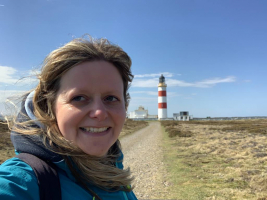
What appeals to me about lighthouses ....
Recorded 2 years ago

 About this recording
Sarah Kerr is the author of The British Lighthouse Trail: A Regional Guide. This is the ultimate guide to all major and minor lighthouses in Scotland, England, Wales, Northern Ireland, the Isle of Man and Channel Islands.
Although born on the Isle of Wight, Sarah now lives in Melvich, Sutherland on the north coast of Scotland.
Her first memory of visiting a lighthouse was when her grandparents stayed in one of the keepers’ cottages at Cromar Lighthouse in Norfolk.
Sarah explains that her interest in lighthouses really began in 2010 when she went on a lighthouse tour with some friends. This sparked her determination to attempt to visit as many lighthouses as possible.
She describes the resulting book, as the book she wished she had while visiting lighthouses on this tour. She was also keen to have more than just a list, so photographs were taken to make the book more appealing. The book was published in 2019 by Whittles Publishing, and Sarah is full of praise for their support during the production process.
Sarah has been a member of the Association of Lighthouse Keepers since 2013 and some time later took on the role as Events Co-ordinator.
From her Melvich home she is able to view the lighthouse at Dunnet Head, and on really clear nights the Torness Light on Hoy is also visible. The Dunnet Head light has a sweeping beam whereas Torness is a flashing LED light.
Sarah feels fortunate living near the Pentland Firth, as she is able to enjoy visiting a number of lighthouses in the evenings, to get the experience of watching the lights come on, and appreciating the different ways in which each operates.
The Pentland Firth has a number of lighthouses – Pentland Skerries, Duncansby Head, Stroma, Swona, Torness and Dunnet Head.
In this recording, Sarah describes the history of these lighthouses in terms of their origins and their construction. She explains that in 1789, the twin lighthouses on Muckle Skerry were built by the famous Stevenson lighthouse builders, working for the Commissioners of Northern Lighthouses. The lighthouses were constructed to help guide shipping sailing the Pentland Firth.
David Alan Stevenson was the designer of the Duncansby Head lighthouse. It was one of the last to be built in Scotland, and its light was first lit on 15th March 1924. It is one of a square design as opposed to the usual round towers.
Discussions as to the establishment of a light at Duncansby Head had been considered much earlier, but the light at Noss Head was built instead, although Sarclet Head was actually being seriously considered at that time.
Duncansby Head light was eventually automated on 31st March 1997.
During her tours of lighthouses, Sarah has particularly enjoyed the challenges associated with getting to the more remote island lighthouses. Some of the boat journeys she describes as “especially scary.”
Another feature that attracts Sarah is the changing landscapes, due to the impact of the weather conditions. This makes each visit unique and atmospheric.
 Contributors

 Photos